
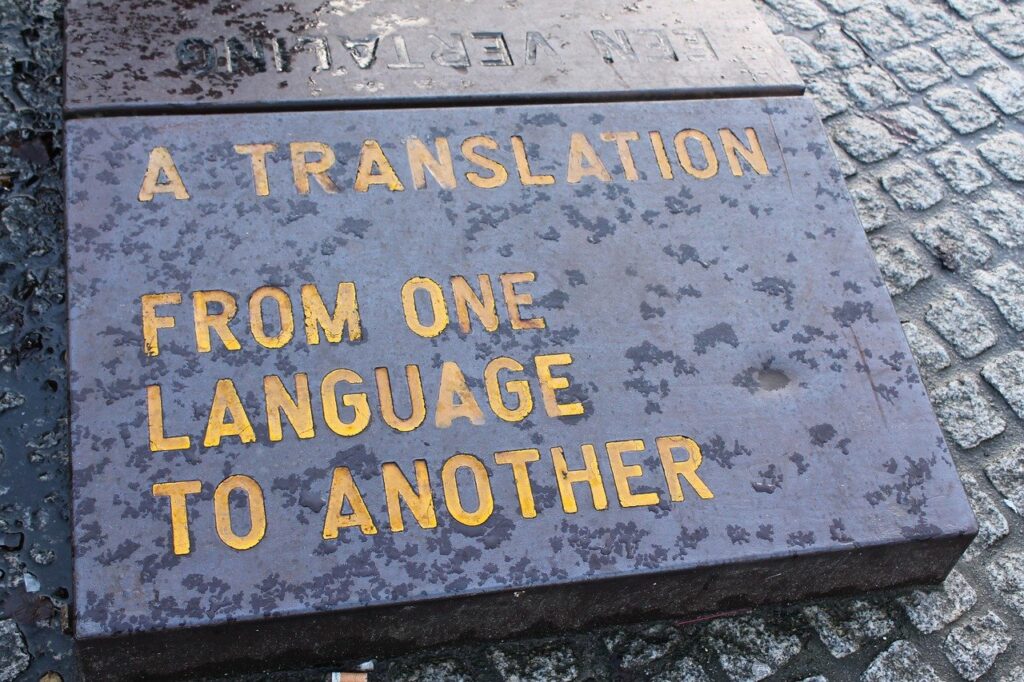
Considering the business I’m in, you can probably appreciate that I spend an inordinate amount of time trying to come up with the ‘best’ way to effectively transform the words and concepts of one language into another, or rather into my mother tongue, which is English. Although my main source language – Italian – is not as far removed from English as, say, Chinese, I still come up against a good number of ‘head-scratchers’, by which I mean words and expressions that don’t easily translate, or that at least require careful thought. Any fellow translators reading this will know exactly what I mean, but I thought it might be interesting to consider a few together – at the very least, it will provide non-linguists with some insight as to the contrasting/differing ways we express ourselves depending on the language we are using.
The first word we’re going to look at is EMOZIONE, which translates in the simplest and most literal sense as EMOTION. So far, so easy. But the problem has more to do with the multitude of ways Italians will use it in everyday situations. It’s common to use phrases like, ‘che emozione!’ or perhaps ‘mi sono emozionata‘, or even an object that ‘trasmette emozioni‘. As you probably know, the Italians are a very passionate people and so we perhaps shouldn’t be surprised by all this talk of ’emozioni’ (and ‘passione’ too, come to that). But it is also clear that none of the examples I just provided can be translated literally, and the type of word we opt for in the English text very much depends on the context in which it is used in the source language.
If an Italian exclaims ‘Che emozione!‘, they are generally excited or thrilled about something – I’ve come across it when a rider talks about a making a lap of the racetrack for example, so a phrase like ‘What a rush!’, ‘So exciting’, or even a simple ‘Amazing!’ might work, again depending on context of course. And not only context, because the translator must also consider whether the English version is for a particular audience, as a certain phrase in UK English may not work in US English for example. As for ‘mi sono emozionata‘, we could be looking at a translation more along the lines of ‘I was overcome’, ‘I was moved’ but, equally, this could also be interpreted as ‘I was excited’ – again, it very much depends on context, which is of paramount importance. On a side note, some of the trickiest things to translate are standalone phrases or words for which you, the translator, is not given any kind of context at all (think headings or perhaps items in an index) – there can sometimes be numerous options in these cases, and you may actually have no way of knowing which is ‘right’ unless you refer back to the client. As mentioned above, another one I come across on a regular basis is the concept of the motorcycle ‘transmitting emotions’ to its riders, to translate literally from Italian. This of course sounds odd to an English ear, and there are various solutions but none of them in fact involve the word emotion. I might talk about ‘conveying a certain sensation/feeling’ or the phrase might need to flipped around, if we think the rider is left ‘giddy’ or ‘exhilarated’ by the bike.
In coming up against this kind of phraseology on a regular basis, you start to appreciate the subtle nuances of each language and consider specific words and their usage and weighting in a way a monolingual individual simply does not need to. And in an age of machine translation, I think that this is one of the areas in which the human translator will continue to have the upper hand for a long time to come. A machine can only translate on the basis of what it already ‘knows’, that is, what it has stored in its memory. But the term used to translate ‘emozione’ the first time around may simply not fit the context the second time it occurs in a text. And this is where the human translator comes into their own, able to carefully consider the context, tone, and subject matter of the text and come up with myriad solutions or alternatives to any given linguistic problem.


 Italian
  English